Include Safety Labels in Your Model
Safety labels are always necessary; even in manuals, according to ANSI Z535.6.14 They communicate potential life threatening hazards. Therefore, it is essential to keep operators – and co-workers – safe. Including safety labels in your models illustrates to purchasing that they need to source specific labels. Including safety labels in your models tells manufacturing where they should be placed. Including safety labels in your models tells customers – those who see the design prior to the machine being actualized – that you and your company are serious about operator safety.
Where You Should Place Safety Labels
According to Z535.4, section 8.2.2, you must determine a “safe viewing distance” and “take into consideration” a realistic reaction time for the average operator to avoid a hazard. Furthermore, “[p]roduct safety signs and labels” must be located in such a way that they are “…readily visible” so the operator is “alert[ed]…to the potential hazard,” according to section 9.1.15
OSHA’s 1910.145 expands on Z535.4, sections 8.2.2 and 9.1, stating: “Tags shall be affixed as close as safely possible to their respective hazards by a positive means such as string, wire, or adhesive that prevents their loss or unintentional removal.”16
Also, according to OSHA, labels must be placed anywhere a hazard exists.17
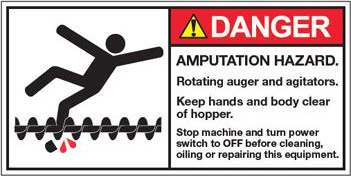
With that in mind, let’s go over some examples of when and where to include safety labels. Before starting, if you have a Safety Officer, speak with them and run through a short risk assessment of your machine. If you don’t have a designated Safety Officer, run through a short risk assessment on your own to determine what kinds of signs and labels you will need to include.

Signs and labels with a danger heading, should be place on:
- Electrical Enclosures – to warn of high voltage and potential arc flash.
- Doors, fences, and panels behind which a severe risk is present when opened or removed.
- These types of danger labels should also include a statement outlining the risks of defeating interlocks or improperly handling the machine’s safety system.
- On equipment inside the work cell that can crush or hospitalize the operator or maintenance technicians.
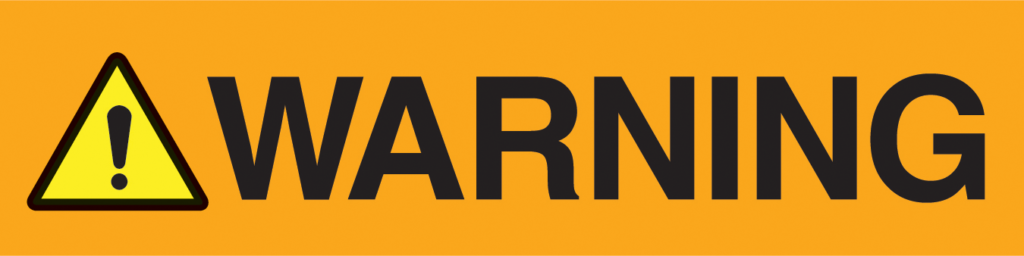
Signs and labels with a warning heading, should be place on:
- Doors, fences, and panels behind which a potential hazard is present when opened or removed.
- On conveyors where crush points could exist if the operator is not careful.
- On equipment that, if not handled appropriately, could pose a severe risk.

Signs and labels with a caution heading, should be place on:
- Doors, fences, and panels behind which a potential risk may be present when opened or removed and if handled improperly.
- These labels could include a note about the potential for Class IV radiation if safety interlocks are defeated or if panels are not properly replaced.
- Equipment that may cause harm if the machine is handled improperly.
- Potential pinch points that may cause damage, but will not hospitalize the operator.

Signs and labels with a notice heading, should be place on:
- Surfaces that may also contain Danger, Warning, or Caution labels that display additional recommendations of handling the machine.
- These labels may include things like:
- Wear eye or ear protection before opening a door or removing a panel.
- These labels may include things like:
- Doors or panels that lead to non-hazardous equipment that should be handled with care.
- Panels or enclosures
- These may include warnings or rules that will mitigate troubleshooting or will extend the machine’s lifespan.
- Example: Do not clean rails – bearings and other equipment will be damaged.
- These may include warnings or rules that will mitigate troubleshooting or will extend the machine’s lifespan.

Signs and labels with a instruction heading, should be place on:
- Doors or panels to display additional steps the operators can take to remain safe and keep the machine functional.
- Equipment that must be handled in a particular manner to ensure longevity or operator safety.
Conclusion
Acclaim Automation hopes you learned something useful in this course. We want to stress, of course, that the information herein should not be taken as gospel. Use these recommendations in accordance with your company’s internal guidelines. Always consult with your managers before adding anything out of the ordinary to your designs. Should you use these recommendations, make sure you are in compliance with OSHA regulations and your company’s standard operating procedures.
Should you cite the information you learned from this course and potentially wow your managers and co-workers, send them our way. If you noticed anything misrepresented in this course, definitely let us know. We love to learn and implement new knowledge into our lessons.
Thank you so much reading through this! If you’re interested, go ahead and show yourself what you’ve learned and take the quiz below! And show some of our other courses some love by clicking the additional links below.
14 ANSI Z535.6-2011 (R2017) – Product safety information in product manuals, instructions and other collateral materials. (n.d.). https://webstore.ansi.org/standards/nema/ansiz5352011r2017-1668876?source=blog&_gl=1*2whb0l*_gcl_au*OTkyNTg1MzgzLjE2OTM4MzQ2MDE.
15 Safety warning labels for machines and equipment. (n.d.). https://manufacturingsafety.com/Warning_Signs.html
16, 17 29 CFR 1910.145 — Specifications for accident prevention signs and tags. (n.d.-b). https://www.ecfr.gov/current/title-29/subtitle-B/chapter-XVII/part-1910/subpart-J/section-1910.145